How Fast Should Hotels Respond to Guest Requests in 2026?
As guest services manager, you’re juggling dozens of tasks at a time; speed and communication are just as important as the hotel guest experience. You depend on fast turnover times, which means staying in close communication with housekeeping and engineering. Your focus is on greeting guests warmly and with poise, even with a list of must-dos running in the back of your mind. But when it’s 5:00 PM on a Friday and the lobby is buzzing, the phone lines are ringing, and a lineup of weary travelers is waiting to check in, the guest who stops by to let you know the AC in room 1310 is blowing nothing but warm air is all it takes to send that running list straight into the ether. It’s all but impossible to stop everything you’re doing to see the AC issue through in the moment, and now you’ve lost track of several other pressing demands.
The phone rings again, a credit card machine acts up, and three more families arrive. In all that controlled chaos, room 1310’s broken AC gets buried. By the time your guests reiterate their complaint, the magic is gone. Soon after they check out, a stinging one-star review goes live online. A simple maintenance hiccup turned into a total hospitality breakdown because of a communication failure.
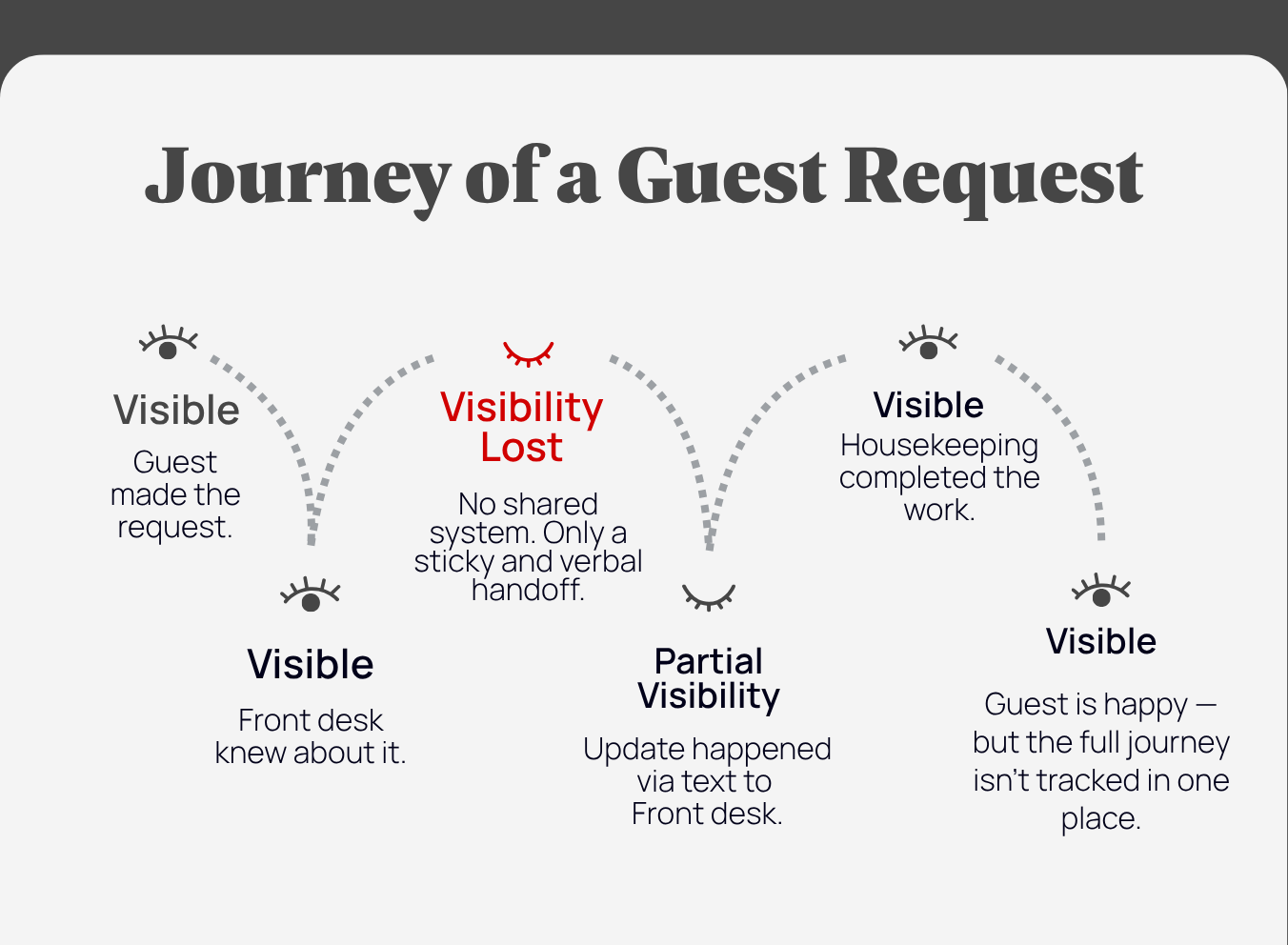
For decades, hotel teams have relied on a mix of log books, a mountain of sticky notes, and walkie-talkies to keep hotel communication flowing across front desk, housekeeping, and engineering. But in an era where guests expect fast, convenient service, these tools can't keep up, especially when shift changes roll around. Whatever was written down in a notebook or conveyed over the airwaves can easily get lost in the shuffle. That’s when teams become siloed. The front desk knows one thing, housekeeping knows another, and engineering has its own list of issues to address. When teams are asked to run a 21st-century hotel with 20th-century tools, disconnects are inevitable. No one is failing at their job; the system is failing the team.
How Fast Should Hotels Respond to Guest Requests?
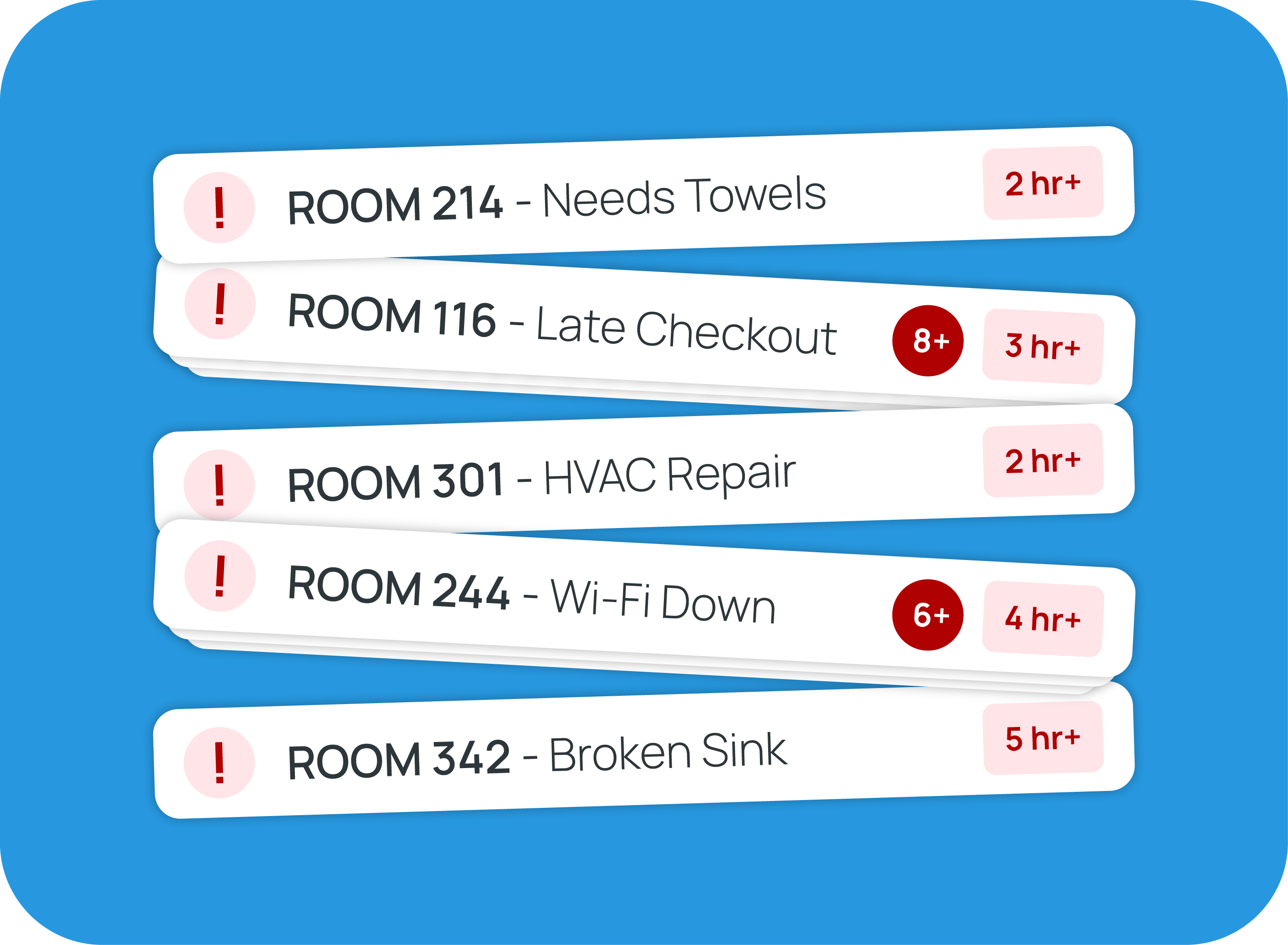
Response speed is one of the most critical factors in modern hotel guest satisfaction, but no single response time makes sense for every guest request. An extra pillow isn’t as urgent as a broken AC or an overflowing toilet. While guests don’t necessarily expect every problem to be fixed instantly, they do expect quick acknowledgment and to know someone has taken ownership of the issue. What’s vital is having a system that can capture requests, route them quickly, and keep them moving without relying on someone at the front desk to remember every open item.
A prompt acknowledgment lets your guests know their request has been heard. An update tells them it didn’t slip into a void and that a resolution is underway. And if the repair will take longer than expected, proactive communication gives the front desk a chance to offer another solution before a guest’s frustration becomes a complaint.
So speed is less about racing against the clock and more about maintaining visibility. Guests need to know the hotel is responding. The front desk needs to know where a request is in the queue and when a guestroom is back in inventory. Engineering needs to know what requires immediate attention. And managers need to know where service is slowing down so they can identify and address recurring bottlenecks.
That kind of visibility turns response time from guesswork into something tangible. Instead of asking whether requests are being handled fast enough, managers can see where delays occur, how quickly requests are picked up, and where operations have room to improve.
How Can Hotels Track and Improve Guest Response Times?
Today, tracking guest response times and surfacing delays is easier than ever. But measuring speed is only one part of the guest experience. That's where adding more technology can create new challenges. If your hotel is committing to subscription after subscription for apps designed to streamline individual activities, your team can wind up buried all over again. This time, it’s in passcodes, competing interfaces, and confusion around who’s handling what.
A better approach is connecting guest communication directly to operational execution, with response data living in the same system your team uses to manage requests.
Quore connects response-time reporting with the day-to-day workflows generating that data, giving managers visibility into what’s happening across the hotel without adding another disconnected system to the mix.
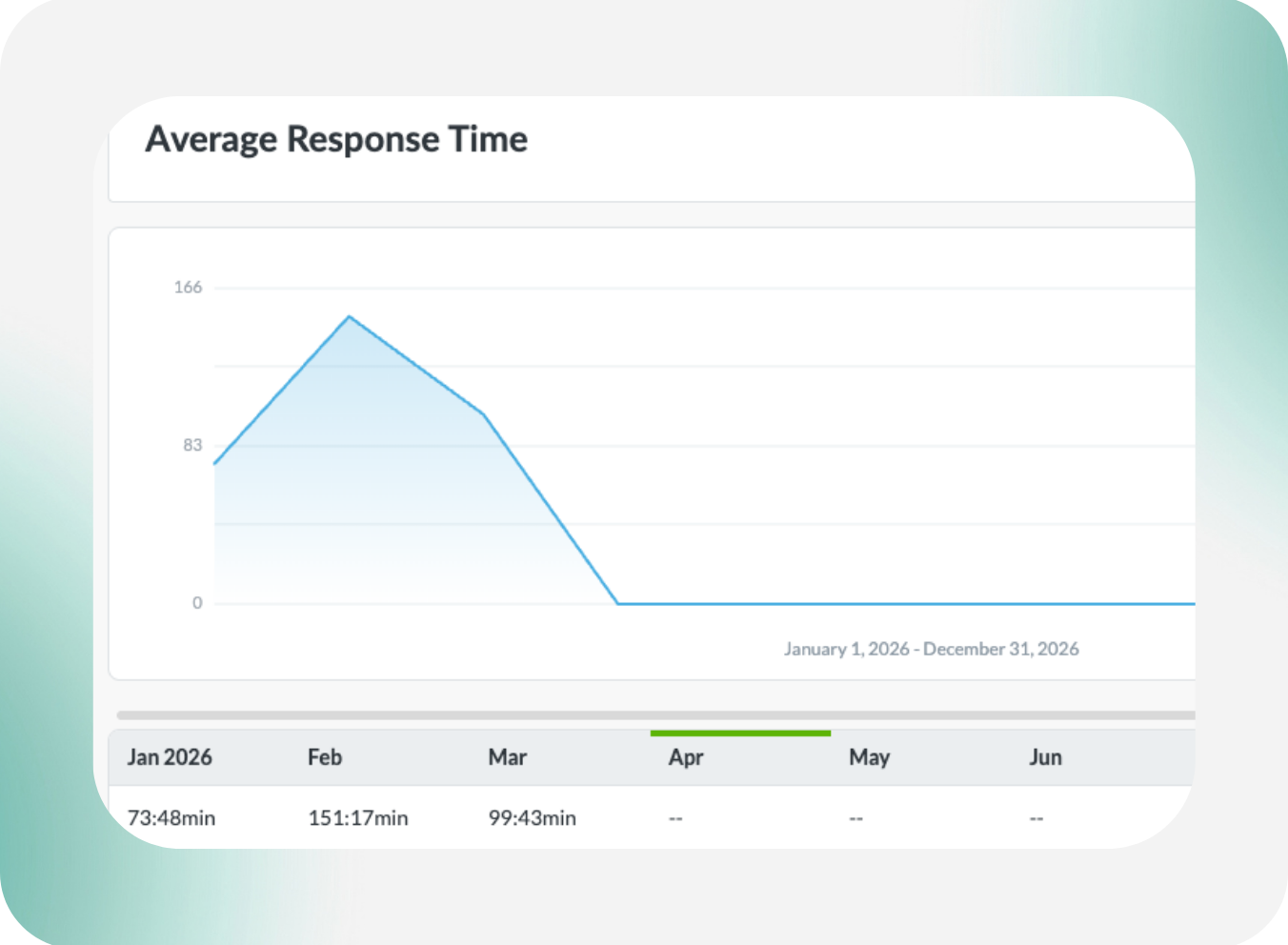
Quore’s Response Time measures the time between when a guest-related Request or Work Order is posted and when someone starts it. Resolution times will naturally vary depending on the problem, but response-time data can reveal how long a guest request is sitting before anyone begins addressing it.
Rather than looking at one delayed request in isolation, managers can use reporting to identify patterns:
- Are certain types of requests consistently taking longer to reach the right department?
- Are response times creeping up during particular shifts or peak-demand periods?
- Is there an opportunity to adjust staffing, workflows, or accountability?
Hotel guest request software that connects reporting to day-to-day operations gives managers the information they need to ask better questions and make targeted improvements.
Quore also brings Guest Satisfaction levels into the Dashboard alongside Response Time information, helping managers look beyond speed alone. Together, those insights provide a clearer picture of where service is working as intended and where operational adjustments may be needed.
Turning Faster Communication Into Better Service
Measuring response times is one thing. Transforming that knowledge into better service property-wide is another. When a guest-related Request or Work Order is created in Quore, the appropriate team members receive a push notification. Escalation alerts help keep urgent needs from getting lost. This unified visibility helps improve turnover times by keeping the front desk, housekeeping, and engineering informed as issues are identified, addressed, and closed out.
Quore also connects the operational side of service with guest messaging. Through Connect and integrations with leading hotel communication systems, messages can become actionable guest requests rather than a passing comment the front desk must relay manually. With integrations such as Canary + Quore, details including the room, requested item, and urgency can move with the request, while the front desk maintains visibility into its status. A hotel guest communication app makes reaching hotel staff fast and easy, but connecting that communication to the people responsible for addressing it is what keeps service humming.
How Can Hotels Improve Service Recovery?
This is the hospitality industry. Even when everything is running smoothly, something is bound to go wrong. When this happens, service recovery means knowing what happened as quickly as possible and following through on a resolution. Quore can alert staff and management to complaints by text, push notification, or email, while giving teams a place to document complaints and resolutions and schedule satisfaction callbacks after Requests or Work Orders are completed. That lets the front desk confirm whether room 1310 is comfortable again, rather than assuming their silence means satisfaction.
Technology alone won't improve guest satisfaction. But when a single platform gives your staff one place to communicate, act, follow up, and stay accountable, they can spend less time chasing information and more time delivering the hospitality that can improve guest experience at every touchpoint.
Stay one step ahead so every guest interaction feels seamless. Contact Team Quore.